
Index
- What Is Rhythmic Gymnastics?
- A Brief History of Rhythmic Gymnastics
- What Categories Are There in Rhythmic Gymnastics?
- What Levels Are There in Rhythmic Gymnastics?
- What Does Rhythmic Gymnastics Involve?
- What Clothing Do You Need for Rhythmic Gymnastics?
- What Apparatus Do I Need for Rhythmic Gymnastics?
What Is Rhythmic Gymnastics?
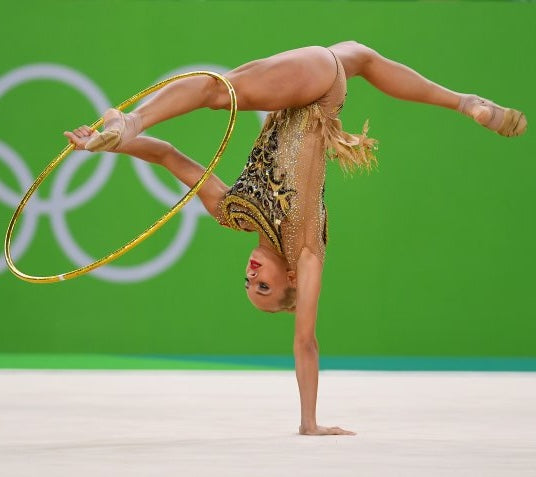
Rhythmic Gymnastics is a sport that combines several elements such as gymnastics, dance, acrobatics and choreography.
A Brief History of Rhythmic Gymnastics
Its origins date back to the 19th century, when the first movements and expressions inspired by the Enlightenment thinker Rousseau began to appear. Around 1950 the first competitions emerged, and in 1963 the sport was recognised as an Olympic sport.
This sport demands a high level of strength, coordination, flexibility and balance. Gymnasts perform a series of exercises on a mat, accompanied by music to complement the movements and follow the rhythm. Individual routines last 90 seconds, while group routines (five gymnasts) last 150 seconds.
What Categories Are There in Rhythmic Gymnastics?
Categories in Rhythmic Gymnastics are divided by age (these are the age groups used in the Spanish system):
- Prebenjamín
- Benjamín
- Alevín
- Infantil
- Cadete / Junior
- Juvenil / Senior
What Levels Are There in Rhythmic Gymnastics?
The levels are designed to suit the abilities and needs of each gymnast:
- Pre-competitive
- Initiation
- Intermediate
- Advanced
What Does Rhythmic Gymnastics Involve?
In Rhythmic Gymnastics, athletes develop skills such as flexibility, strength, endurance and agility. Routines combine body movement, handling of the apparatus and musical accompaniment.
What Clothing Do You Need for Rhythmic Gymnastics?
For competitions, leotards approved by the relevant federation are used, made of elastic fabrics. Sheer fabrics are not permitted. The typical footwear is toe shoes (half shoes), and it is recommended to have at least two pairs: one for competing and another for training. Hair must be worn in a bun, using accessories such as hair nets for better hold.
What Apparatus Do I Need for Rhythmic Gymnastics?
The International Gymnastics Federation (FIG) chooses which apparatus are used in competitions, selecting four of the five available. In Spain, the RFEG (Real Federación Española de Gimnasia, the Royal Spanish Gymnastics Federation) determines the apparatus each season.
The 5 apparatus of Rhythmic Gymnastics are:
-
The Ball: Made of rubber or synthetic materials, available in various sizes and weights.
At INDIGO we always seek the best materials to make quality balls that allow a precise grip and firm movements. See our balls
-
The Rope: Made of polyester, nylon or other materials, with a length adjusted to the gymnast's height.
At Indigo we offer ropes of 2.5 and 3 metres to suit all levels. See our ropes
-
The Clubs: Consist of two clubs, shaped like bottles, made of synthetic materials.
Indigo has several options, from non-connectable clubs for beginners to connectable clubs for advanced training. See our clubs
-
The Ribbon: Consists of a stick and a ribbon, and requires great skill and technique.
Indigo offers ribbons and sticks in various sizes, as well as a wide range of colours. See our ribbons
-
The Hoop: Made of plastic, often decorated with coloured adhesive tape.
At Indigo we have hoops in all sizes, designed to be durable and resistant. See our hoops

